


Science
Intent
In choosing the Primary Knowledge Curriculum for our Science planning and curriculum structure, we are ensuring that our children will leave RHS with curiosity, passion and a desire for discovery as well as being well-equipped for the rigours of secondary education.
The comprehensive curriculum we provide means that we go above and beyond the requirements of the National Curriculum and develop pupils’ understanding of earth sciences and environmentalism that reinforces our intent to help create the next generation of citizens who are compassionate and caring towards the world and society around them.
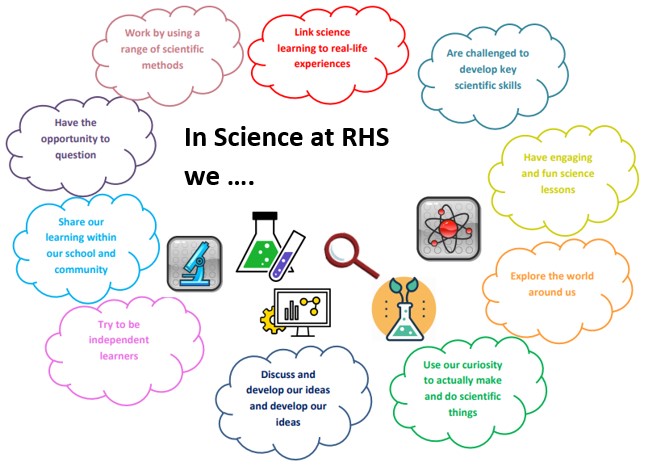
Our curriculum provides all pupils with a comprehensive knowledge base, along with the confidence to work scientifically, conduct experiments, and think critically. Aligned with the aims of the National Curriculum, our Science teaching offers children the opportunity to:
- Develop scientific knowledge and conceptual understanding through specific scientific themes
- Understand the nature, processes, and methods of Science through diverse scientific enquiries that help them answer questions about the world around them
- Acquire the scientific knowledge necessary to appreciate the uses and implications of Science today and in the future
- Build essential scientific enquiry skills to deepen their knowledge
- Communicate scientific information systematically using a variety of methods, including ICT, diagrams, graphs, and charts
- Demonstrate respect for materials and equipment, prioritising safety for themselves and others
- Cultivate enthusiasm and enjoyment for scientific learning and discovery.
Our various topics are linked to the units of study in History, Geography, Design Technology (DT) and Art. For example, in Year 5, the unit on Materials makes links with pupils’ prior learning about cams mechanisms in DT.
Implementation
Implementing Primary Knowledge Curriculum allows us to take an incremental approach to developing pupils’ knowledge and understanding with multiple opportunities for consolidation and revisiting prior learning.
This approach allows teachers to ensure that pupils have the sufficient breadth and depth of scientific knowledge, skills and understanding to make good progress. Additionally, this allows pupils to develop their understanding of the discipline of science as being a pursuit that builds on what has gone before: in the words of Sir Isaac Newton, “standing upon the shoulders of giants.”
The development of scientific discipline is supported through regular practical enquiries that promote the pupils’ understanding of the five types of enquiry: observing over time; pattern-seeking; identifying, classifying and grouping; comparative and fair testing; and researching using secondary sources. This allows pupils to better differentiate between Science and other subjects in terms of its approach to uncovering information and starting from first principles.
Impact
Our approach results in a fun, engaging, and high-quality science education that provides children with a strong foundation for understanding the world beyond primary school. We recognise the value of outdoor learning and regularly provide opportunities for children to experience science outside the classroom.
Through the exploration of different scientists throughout history from a wide range of backgrounds and cultures (such as Lewis Howard Laitmer and Jabir ibn Hayyan), pupils will see that diversity is a strength of the discipline and that anyone can be a scientist.
Ultimately, we want every child at Rutherford House to see themselves as scientists, forever curious, eager to explore, and inspired by the wonders of the natural world.
Vision of Science at RHS